Istanbul's largest and most magnificent Byzantine water reservoir
The Basilica Cistern, known in Turkish as Yerebatan Sarnıcı (literally "Sunken Palace"), is the largest of several hundred ancient cisterns that lie beneath the city of Istanbul. Built in 532 CE during the reign of Byzantine Emperor Justinian I, this magnificent underground chamber could store up to 80,000 cubic meters of water.
The cistern's name comes from the great Basilica that once stood on the site before it was demolished by a fire in 476 CE. Today, visitors descend stone steps to find themselves in a vast, dimly lit space supported by a forest of 336 marble columns, each 9 meters high, arranged in 12 rows of 28 columns each.
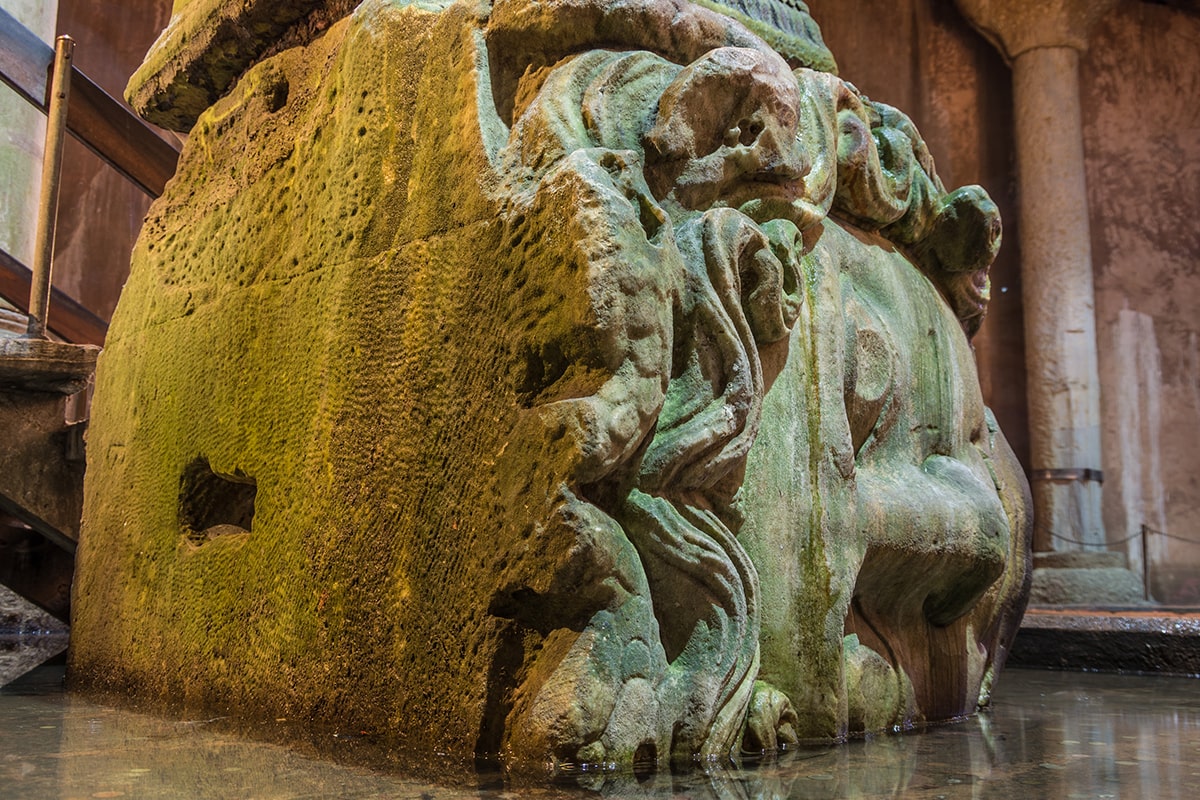
Perhaps the most intriguing features of the Basilica Cistern are the two massive Medusa head sculptures used as column bases in the northwest corner. One head is placed sideways, while the other is upside down, creating an eerie and mysterious atmosphere.
Why upside down? Historians debate several theories:
336 marble columns, each 9 meters high, support the brick vaults. Most were recycled from earlier Greek and Roman structures, showcasing various architectural styles including Ionic and Corinthian capitals.
The ceiling consists of brick vaults supported by cross-shaped arches. The walls are 4 meters thick and coated with a special waterproof mortar made from brick powder.
Water was transported via the Valens Aqueduct from the Belgrade Forest, 19 km north of Istanbul. The cistern could supply water for the entire Great Palace complex.
Emperor Justinian I orders the construction of the cistern to supply water to the Great Palace and surrounding buildings.
After the conquest of Constantinople, the Ottoman Turks continued using the cistern for a period but gradually developed alternative water systems.
The cistern was largely forgotten by the public. Local residents would lower buckets through holes in their basements to draw water - and even catch fish!
French scholar Petrus Gyllius rediscovered the cistern while researching Byzantine antiquities. He explored it by torchlight in a small boat.
Istanbul Metropolitan Municipality cleaned and restored the cistern, adding walkways and dramatic lighting. It opened to the public as a museum.
Today the Basilica Cistern welcomes thousands of visitors daily and has been featured in numerous films, including James Bond's "From Russia with Love".
The cistern served as a filming location for this classic James Bond film. The atmospheric underground setting provided the perfect backdrop for espionage and intrigue.
The Basilica Cistern features in Dan Brown's thriller novel "Inferno" and its 2016 film adaptation, where it plays a key role in the mystery.
The cistern's exceptional acoustics make it a unique venue for classical music concerts, offering an unforgettable auditory and visual experience.
Early morning (9-10 AM) or late afternoon (4-5 PM) to avoid the biggest crowds. The cistern is busiest between 11 AM and 3 PM.
Wear comfortable shoes with good grip - the walkways can be slippery. The temperature inside is cool (around 13°C/55°F), so bring a light jacket.
Photography is allowed! The dim lighting creates atmospheric photos. Use a camera with good low-light performance or bring a small tripod.
Purchase tickets online in advance to skip the queue. Combined tickets with other cisterns are available at a discounted price.
Plan for 45 minutes to 1 hour to fully explore the cistern, read the information panels, and take photos.
The cistern has stairs at the entrance and may be challenging for visitors with mobility issues. Contact ahead for accessibility options.
Experience the magic of the Basilica Cistern - Istanbul's most magnificent underground wonder