Dive into the sophisticated hydraulic engineering of the Byzantine Empire. Explore how ancient cisterns like the Basilica and Şerefiye sustained Constantinople through sieges and droughts, offering timeless lessons in urban resilience. Learn about their current state and preservation efforts.
When walking through the historic peninsula of Istanbul today, amidst the lively chatter of tourists and the call to prayer echoing from minarets, it is easy to forget that a silent, watery world lies beneath the cobblestones. For the modern traveler in January 2026, the surface of the city tells a story of conquest and culture, but the underground tells a story of survival and engineering genius. The Byzantine Empire, centered in Constantinople, faced a unique geographical paradox: it was a city surrounded by sea on three sides, yet it suffered from a chronic lack of fresh spring water. To sustain a growing metropolis that would eventually house half a million people, Byzantine engineers developed one of the most sophisticated water management systems the ancient world had ever seen. This network did not just provide a luxury; it was the very lifeline that allowed the city to withstand centuries of sieges and hot, dry summers.
The Hydraulic Challenge of Constantinople
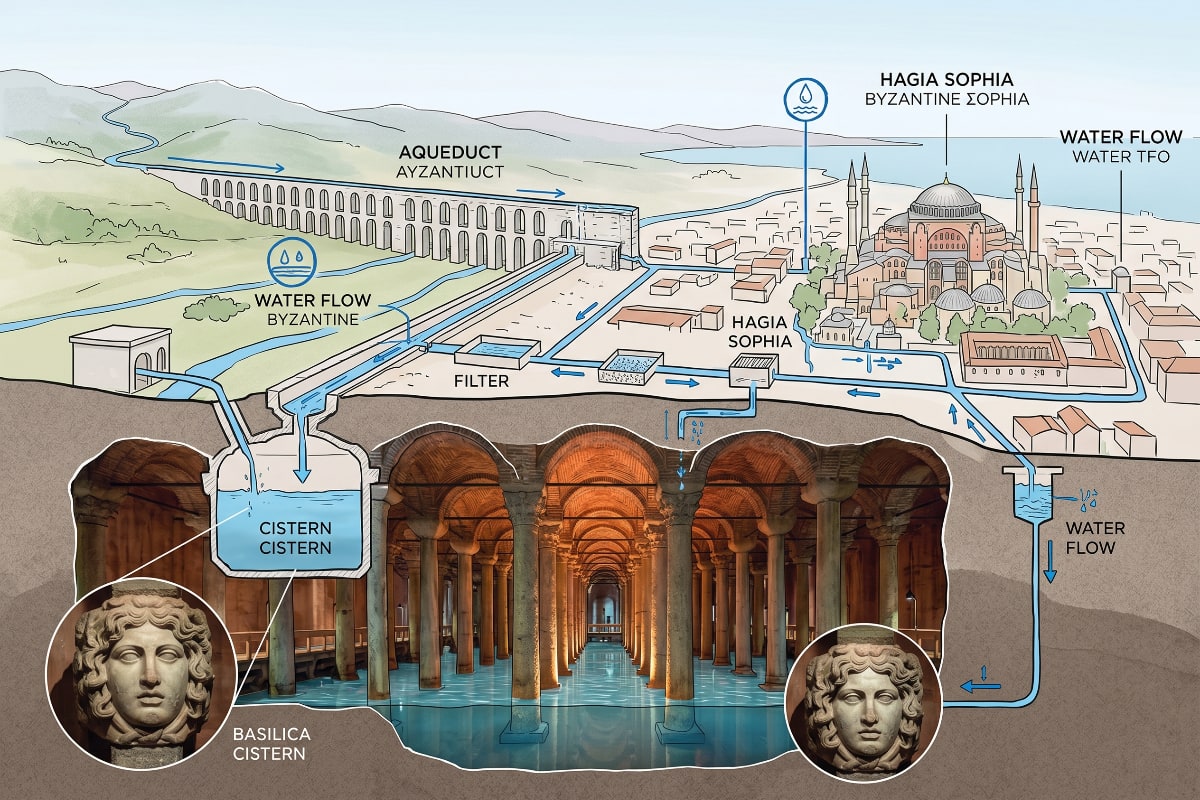
Constantinople’s strategic location was perfect for defense and trade, but hydrologically, it was a nightmare. The peninsula lacked sufficient natural aquifers to support a large population, and the few small streams that existed dried up quickly during the summer months. Recognizing this vulnerability, Emperors from Constantine to Justinian invested heavily in hydraulic infrastructure. They understood that water was a matter of national security. If an enemy army cut off the aqueducts—the external veins bringing water from the Belgrade Forest—the city would fall within days. The solution was a two-tiered system: bring the water in from miles away via massive aqueducts like the Valens, and then store immense quantities of it within the city walls in both open-air reservoirs and subterranean covered cisterns. These underground cathedrals of water were designed to hold enough reserves to keep the city alive for months, even if every external pipe was severed.
The Subterranean Giants: More Than Just Storage
The covered cisterns of Istanbul are not merely functional tanks; they are architectural marvels that rival the temples and palaces above ground. They were built with the same care, aesthetic consideration, and structural integrity as the imperial buildings they supported. Visiting these sites offers a glimpse into a mindset where utility and beauty were not mutually exclusive. The sheer scale of these structures proves that the Byzantines viewed water management as a monumental state project, requiring the best architects and mathematicians of the era.
The Sunken Palace: Basilica Cistern
Undoubtedly the most famous of these structures is the Basilica Cistern, known locally as Yerebatan Sarnıcı. Built by Emperor Justinian I in the 6th century, this vast underground chamber was the primary water reservoir for the Great Palace. Walking along its raised platforms, visitors are often struck by the symmetry of its 336 marble columns, rising from the water like a submerged forest. The engineering here is clever; the thick walls are lined with a special hydraulic mortar to prevent leakage, a recipe that has held up for nearly 1,500 years. The famous Medusa heads used as column bases suggest a pragmatic approach to recycling materials from older Roman structures, yet they add a layer of mythological mystery to the damp, echoing atmosphere.
The Cistern of Philoxenos: Binbirdirek
While the Basilica Cistern captures the most attention, the Binbirdirek Cistern offers a different perspective on Byzantine construction. Often called the "Cistern of 1001 Columns" (though the actual number is fewer), it is one of the oldest in the city, dating back to the 4th century. Unlike the watery depths of the Basilica, Binbirdirek is often dry, allowing visitors to appreciate the sheer height of the columns. Each column is actually composed of two drums connected by a marble ring, a unique engineering choice designed to achieve greater height and stability. This structure served the aristocratic neighborhoods near the Hippodrome, proving that water security was a priority not just for the Emperor, but for the entire urban elite.
The Elegant Sanctuary: Şerefiye Cistern
For those seeking a more serene and perhaps more historically intact experience, the Şerefiye Cistern (Theodosius Cistern) is a revelation. Older than the Basilica Cistern by roughly a century, it demonstrates the evolution of Roman hydraulic architecture into the Byzantine style. The columns here are remarkably uniform, bound by Corinthian capitals that support a meticulously comprised brick roof. The restoration of this site has been executed with incredible sensitivity, using lighting to highlight the original brickwork and the tranquil water surface. It stands as a testament to the durability of Theodosian infrastructure, having survived earthquakes and urban redevelopment above its roof for over 1,600 years.
Engineering Techniques and Innovations
The success of these cisterns relied on several key engineering innovations that were ahead of their time. The Byzantines mastered the use of gravity and pressure long before modern pumps existed. Their ability to calculate the precise gradient required to transport water over 250 kilometers from the Thracian hinterland to the city center remains an impressive feat of surveying.
- Hydraulic Mortar (Khorasan Mortar): A mixture of crushed brick, lime, and volcanic ash that created a waterproof seal, preventing the precious water from seeping into the soil.
- Sedimentation Pools: Before water entered the main cisterns, it often passed through settling tanks where mud and debris would sink to the bottom, ensuring the water stored was relatively clean.
- Aeration Systems: The high ceilings and ventilation shafts in structures like the Basilica Cistern were not accidental; they allowed air circulation to keep the water fresh and prevent stagnation.
- Structural Redundancy: The dense grid of columns ensured that if one support failed during an earthquake, the load would be redistributed, preventing a total collapse of the roof.
Comparative Overview of Major Cisterns
To understand the scale of these operations, it is helpful to look at the specifications of the three major cisterns accessible to travelers today. This comparison highlights the variety in design and capacity across different eras of the empire.
| Feature | Basilica Cistern | Binbirdirek Cistern | Şerefiye Cistern |
| Estimated Date | 6th Century (Justinian I) | 4th Century (Constantine) | 5th Century (Theodosius II) |
| Number of Columns | 336 | 224 (Original) | 32 |
| Approximate Area | 9,800 m² | 3,640 m² | 1,000 m² |
| Key Characteristic | Medusa Heads, Watery atmosphere | Tall, double-drum columns | Uniform Corinthian capitals |
Lessons for the Modern World
Studying Byzantine water management offers more than just a history lesson; it provides a blueprint for urban resilience. The Byzantines understood that a city's survival depended on redundancy. They did not rely on a single source or a single storage facility. Instead, they created a decentralized network where neighborhood cisterns complemented the massive imperial reservoirs. In an era where modern cities face climate change and water scarcity, the concept of integrating large-scale water storage into the very foundation of urban architecture is incredibly relevant. They treated water as a precious, finite resource to be captured, filtered, and guarded.
As you explore Istanbul, remember that the ground beneath you is honeycombed with history. Whether you are gazing at the reflections in the Basilica Cistern or admiring the architectural purity of the Şerefiye Cistern, you are witnessing a legacy of adaptation. The Byzantines turned their greatest weakness—a lack of water—into an engineering triumph that allowed their capital to shine for over a millennium.