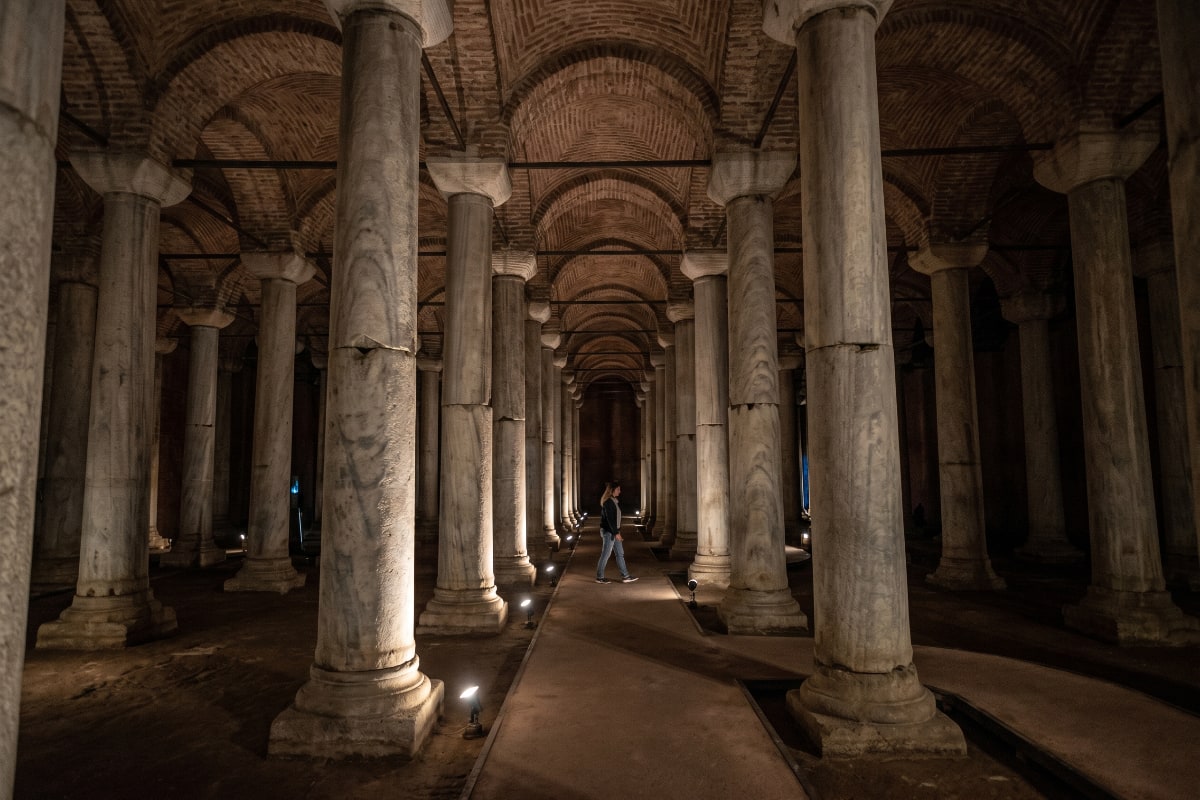
Dive deep into the atmospheric world of the Philoxenos Cistern, Istanbul\'s second-largest underground reservoir. Discover the truth behind its \'1001 columns,\' its unique architectural engineering, its fascinating historical transformation from a Byzantine water source to an Ottoman silk spinning workshop, and tips for planning your visit.
When travelers arrive in Istanbul, their eyes are often drawn upward to the soaring minarets and domes that define the city's skyline. However, true explorers know that a parallel world exists beneath the cobblestones of the Historical Peninsula. While the crowds flock to the famous sunken palace near the Hagia Sophia, a quieter, perhaps more mysterious giant lies waiting to be discovered. This is the Philoxenos Cistern, locally known as the Binbirdirek Cistern, a subterranean marvel that whispers stories of emperors, silk spinners, and architectural ingenuity. As we navigate the cultural landscape of January 2026, this ancient reservoir stands as a testament to the city's enduring ability to reinvent itself through millennia.
The Legacy of Senator Philoxenos
To understand the magnitude of Binbirdirek, one must travel back to the 4th century, a time when Constantinople was just blossoming into the new capital of the Roman Empire. Predating many of the city's most famous structures, this cistern was constructed under the guidance of Senator Philoxenos, one of the leading figures who moved from Rome to Constantinople at the behest of Emperor Constantine the Great. Completed around the year 330 AD, it was designed to serve a critical purpose: supplying water to the surrounding noble palaces and the bustling populace of a rapidly expanding metropolis. Unlike the purely imperial reservoirs, the Philoxenos Cistern was a civic triumph, demonstrating the sophisticated urban planning of early Byzantium.
The scale of the structure was immense for its time, ranking as the second-largest covered cistern in the city, surpassed only later by the Basilica Cistern built by Justinian. Its capacity was staggering, estimated to hold approximately 40,000 cubic meters of water. Standing inside it today, the sheer volume of space is palpable. The air is cool and still, preserving the atmosphere of an era when water was the most precious commodity in a city frequently under siege. It is not merely a container for water; it is a cathedral of engineering built to ensure the survival of an empire.
Debunking the Myth: Are There Really 1001 Columns?
The Turkish name "Binbirdirek" translates literally to "1001 Columns," a phrase that evokes a sense of infinite vastness and fairy-tale wonder. However, this name is more of a linguistic flourish common in Ottoman storytelling to denote "a great many" rather than a literal count. In reality, the cistern originally housed 224 columns arranged in precise geometric rows. Over centuries of earthquakes, urban development, and renovations, some of these have been lost or walled in, but the remaining forest of marble pillars is no less impressive for the mathematical reality.
What truly sets the architecture of Binbirdirek apart from its peers, such as the Şerefiye Cistern, is the unique construction of the columns themselves. Unlike the monolithic pillars found elsewhere, the columns here are composed of two separate shafts stacked one atop the other. This was a brilliant engineering solution to achieve the necessary height without requiring impossibly long single pieces of marble, which were difficult to quarry and transport.
Key Architectural Features
- Superposed Columns: The columns are connected by a marble collar or ring, masking the join between the upper and lower shafts.
- The Greek Inscriptions: Many of the columns bear small Greek letters engraved by the original masons. These were likely marks to track the output of different stonecutters or workshops during construction.
- The Vaulted Ceiling: Small brick domes span the space between the columns, distributing the weight of the city above—a technique that has allowed the structure to survive for nearly 1,700 years.
From Water Source to Silk Workshop
The most captivating chapter in the history of the Binbirdirek Cistern is not its construction, but its transformation. Following the Ottoman conquest of Constantinople in 1453, the city's water systems underwent significant changes. Over time, the Philoxenos Cistern fell out of use as a water reservoir and eventually dried up. However, in a city as dense and industrious as Istanbul, prime real estate is never wasted. The cavernous, cool, and somewhat humid environment of the empty cistern proved to be the perfect setting for a delicate trade: silk spinning.
During the 16th and 17th centuries, European travelers and Ottoman chroniclers reported seeing the cistern bustling not with water, but with weavers. The underground conditions were ideal for silk threads, preventing them from becoming too brittle and breaking during the spinning process. Imagine the scene: shafts of light piercing through the ventilation holes, illuminating hundreds of wooden looms, the sound of shuttles clicking back and forth echoing off the ancient Roman brickwork. This era transformed the cistern from a silent pool into a hive of economic activity, bridging the gap between Byzantine infrastructure and Ottoman industry.
Comparing the Giants: Binbirdirek vs. The Others
For the modern explorer, distinguishing between Istanbul's major cisterns can be challenging. While they share a function, their characters are distinct. Below is a comparison to help you understand where Binbirdirek fits into the underground puzzle.
| Feature | Basilica Cistern | Binbirdirek Cistern | Şerefiye (Theodosius) Cistern |
| Primary Vibe | Grand, watery, mystical (Medusa heads) | Dry, architectural, historically layered | High-tech, visual mapping shows, pristine |
| Column Style | Recycled varied columns | Uniform, stacked (two-tiered) columns | Tall, slender, braced with iron bars |
| Water Status | Contains water and fish | Mostly dry floor | Minimal water reflect pools |
| Best For | First-time visitors | Architecture buffs & history lovers | Art and light show enthusiasts |
The Experience Today
Visiting the Binbirdirek Cistern in 2026 offers a reprieve from the bustling streets of the Sultanahmet district. Upon entering, you descend a staircase that acts as a time machine, leaving the noise of the modern tram and traffic behind. The floor of the cistern is currently dry, which allows visitors to walk among the columns freely, touching the cold marble and appreciating the sheer height of the structure. The original floor level was actually much deeper; over centuries, debris and earth have raised the ground level, meaning a significant portion of the lower column shafts is buried beneath your feet.
The lighting inside is designed to accentuate the geometry of the vaults. It is a favorite spot for photographers because, unlike the crowded walkways of the Basilica, Binbirdirek often offers moments of solitude. The hollow acoustics that once amplified the chatter of silk weavers now amplify the quiet awe of visitors. It is a space that invites contemplation about the layers of history that make up Istanbul—literally and metaphorically.
Why You Should Add It to Your Itinerary
While the lines for other attractions stretch around the block, the Binbirdirek Cistern often remains a peaceful sanctuary. It is situated conveniently between the Hippodrome and the Grand Bazaar, making it an easy addition to a day of sightseeing. It serves as a powerful reminder that history isn't just about what has been preserved in museums, but how spaces adapt. From a Roman water source to an Ottoman workshop, and finally to a modern cultural heritage site, the 1001 Columns tell a story of resilience.
If you have already marveled at the aquatic depths of the Basilica and enjoyed the light shows at Şerefiye, completing the "Cistern Trinity" with Binbirdirek is essential. It provides the missing piece of the puzzle, offering a dry, raw, and authentic look at the engineering prowess that kept the heart of an empire beating for centuries. As you walk back up the stairs to the daylight of January 2026, you carry with you the secrets of the underground, a hidden narrative written in stone and silence.
Planning Your Visit to Binbirdirek Cistern
To make the most of your visit, consider these helpful tips:
- Location: The Binbirdirek Cistern is located in the Sultanahmet district, very close to the Hippodrome and the Grand Bazaar. Its central location makes it easy to integrate into your sightseeing plans.
- Opening Hours: Check the official website or local listings for the most up-to-date opening hours, as they can vary seasonally.
- Admission Fee: There is an entrance fee to visit the cistern. It is generally lower than the Basilica Cistern.
- Photography: Photography is allowed, and the unique lighting and architecture make it a great spot for capturing memorable images.
- What to Wear: The cistern maintains a cool temperature year-round, so bringing a light jacket or sweater is advisable, even in summer. Comfortable walking shoes are also recommended.
- Guided Tours: While you can explore the cistern independently, consider joining a guided tour to gain deeper insights into its history and architecture.
To further enhance your understanding and appreciation of the Binbirdirek Cistern, consider viewing historical maps of Constantinople that illustrate the city's water infrastructure. These maps often depict the location and importance of cisterns like Binbirdirek within the broader urban context. You can find digitized versions of these maps in online archives and museum collections.